Company Story
July 21, 2025
4 min read

What Does OwsterLabs Mean?

The fascinating story behind our name, inspired by Napoleon's greatest strategic victory at the Battle of Austerlitz.

OwsterLabs...

But hey, what does it mean anyway? Owsterlabs sounds more like Oysterlabs. Do we sell oysters? Those fluky, fluffy oysters which everyone loves? Sadly, neither do we sell oysters nor do I eat them, a vegetarian, u see.

Let's imagine a situation. Shall we.

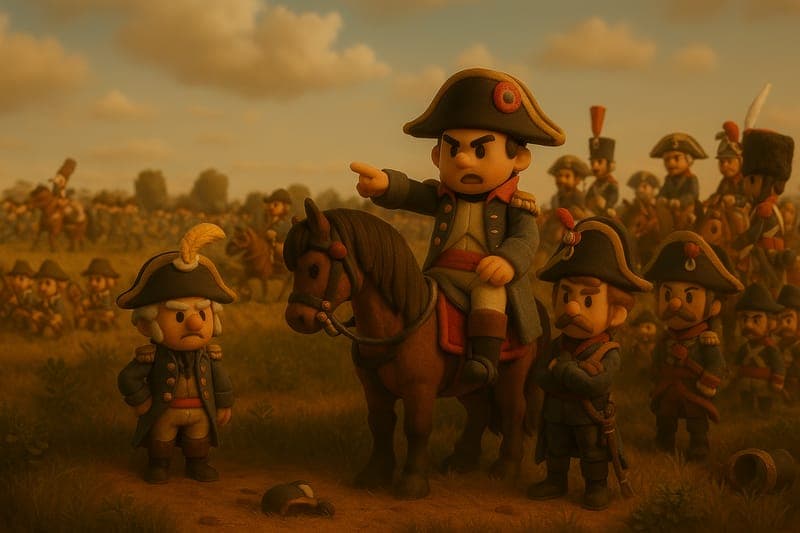
Napoleon Bonaparte mounted on his famous horse Marengo, conducting a pre-battle inspection of his 68,000 troops before the decisive Battle of Austerlitz - December 2, 1805
Napoleon reviewing his army before the legendary Battle of Austerlitz

Napoleon was riding his horse "Marengo" while talking loudly to his Marshals about his upcoming plans. The allied coalition forces seem strong and have a numerical advantage. Some early reports suggested their numbers in the vicinity of 85,000 troops, while his troops are roughly 68,000. The combined forces of Russians and Austrians can bring havoc if not kept in check, but unlike other generals, who would have waited or started attacking at the right time, the generals who were also known as "Le Petit Caporal" were planning something else.

It's a proven fact that being at height gives anyone a massive advantage as it increases your field of view and range, but what if we can change it into a bait, thought the Napoleon. He ordered his centre formation to leave the centre hill position, known as "Pratzen Heights". This move made things quite interesting.

Seeing that the French are leaving the centre hill, the Russians and Austrians are thrilled. The enemy is leaving the hill, which means they are weak and taking defensive formation or even retreating. Plus, their reports suggested that the enemy's right flank seems weak. If they can attack the enemy's right flank and destroy it, Napoleon will be forced into defeat. This was a sound strategy, especially for young Tsar Alexander I, the emperor of Russia. He wanted a decisive victory and consolidated his victory against the demonic French emperor, who was waging wars throughout Europe.

"What if we can change the advantage into a bait?"
— Napoleon's strategic thinking
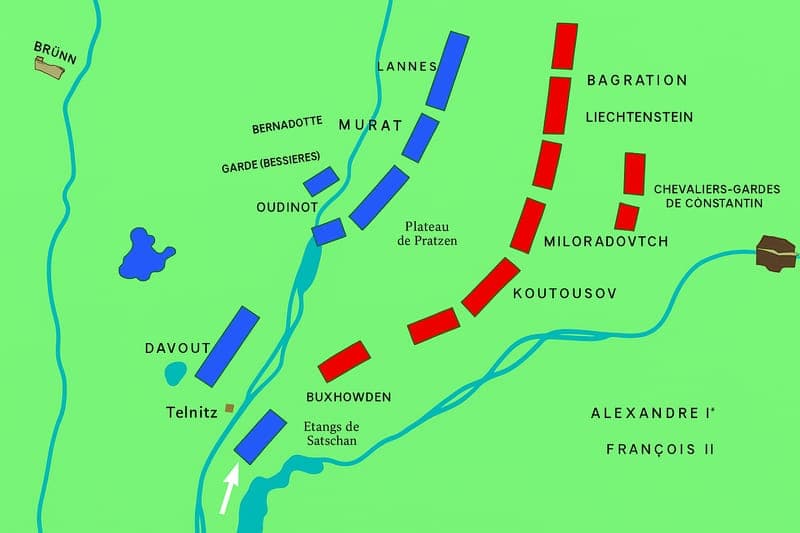
Strategic battlefield map of Austerlitz showing Napoleon's tactical genius - French forces abandoning Pratzen Heights as bait, then executing the famous flanking maneuver against the Allied coalition
Strategic overview of the Battle of Austerlitz - December 2, 1805

So the allied forces do what any other force would have done, they occupy the central position of the battlefield, aka "Pratzen Heights", and launch an attack on Napoleon's right formation. Things suddenly seemed great, the enemy right was crumbling while they were winning, something odd happened..

Scouts reported a sudden reinforcement from Vienna, wait, a sudden confusion erupted in the enemy camp, how is this possible? This was strange. But when it comes to the famous Marshal of Napoleon, i.e. the famous iron marshal, "Louis-Nicolas Davout", nothing is impossible. This lad just marched with his 10,000 troops, covering 70 miles in just 2 days!!

Lo and behold, suddenly the weakened right flank is restored to all-powerful now. Those fresh pairs of 10,000 boots change the situation. Now, due to this right flank push, the enemy reduced troops from the centre, i.e., the Pratzen Heights, in the hope of defeating the enemy from the right side, but the situation changed. Now it's time for a counterattack. Suddenly, Marshal Lannes took the enemy by surprise and launched an all-out attack on "Pratzen Heights". This sudden and powerful attack shook the enemy while the right flank started pushing the allied forces back.
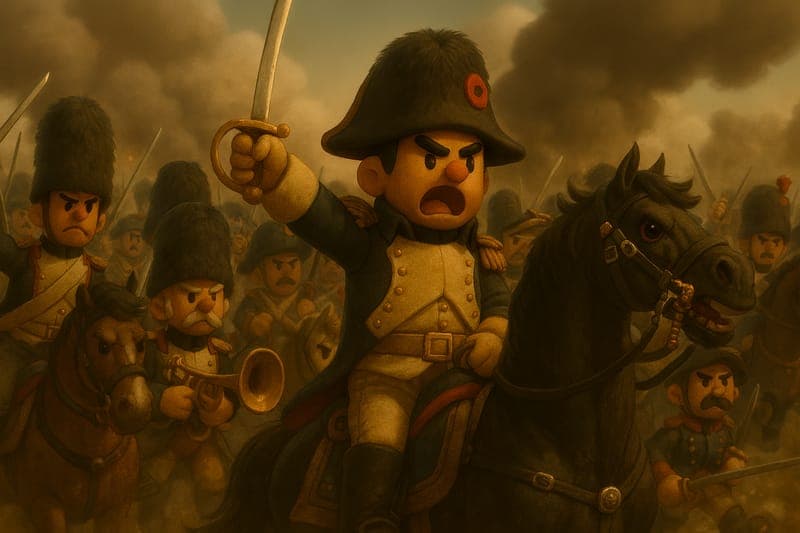
Napoleon Bonaparte leading the dramatic cavalry counterattack that secured victory at Austerlitz - Marshal Lannes recapturing Pratzen Heights while Davout's reinforcements turn the tide
Napoleon leading the decisive counterattack that won the battle

The situation changed suddenly, and now the enemy is on the run as the centre position was taken and the counterattack forced the enemy to retreat.

This battle was one of the most famous battles of the Napoleonic era. Napoleon was able to read his enemy and their decision so well that he laid out his trap so well. This battle was known as the "Battle of Austerlitz". This battle took place on December 2, 1805, at Austerlitz, in modern-day the Czech Republic (then part of the Austrian Empire).

The Connection

Austerlitz is pronounced as "OW-stər-litz", hence it inspired me to use this name for my product. I want to solve the biggest issue I face, i.e., the fear of maths, but maths is all about strategy; it's about solving tough situations using numbers. You see the problem, you plan, and you solve. It's all about strategy. All our learning modules are missions, and hence, they will require a strategy.

Owsterlabs, when pronounced, is called "Ow-ster-labs", somewhat the same as Austerlitz. This is our inspiration for this name, as I am a huge fan of Napoleon Bonaparte.

And yeah, welcome to Owsterlabs. This is gonna make your life awesome. Till then, keep winning.

Ready to Master Your Own Strategy?

Like Napoleon at Austerlitz, every great victory starts with the right strategy. Start your mathematical missions today.